
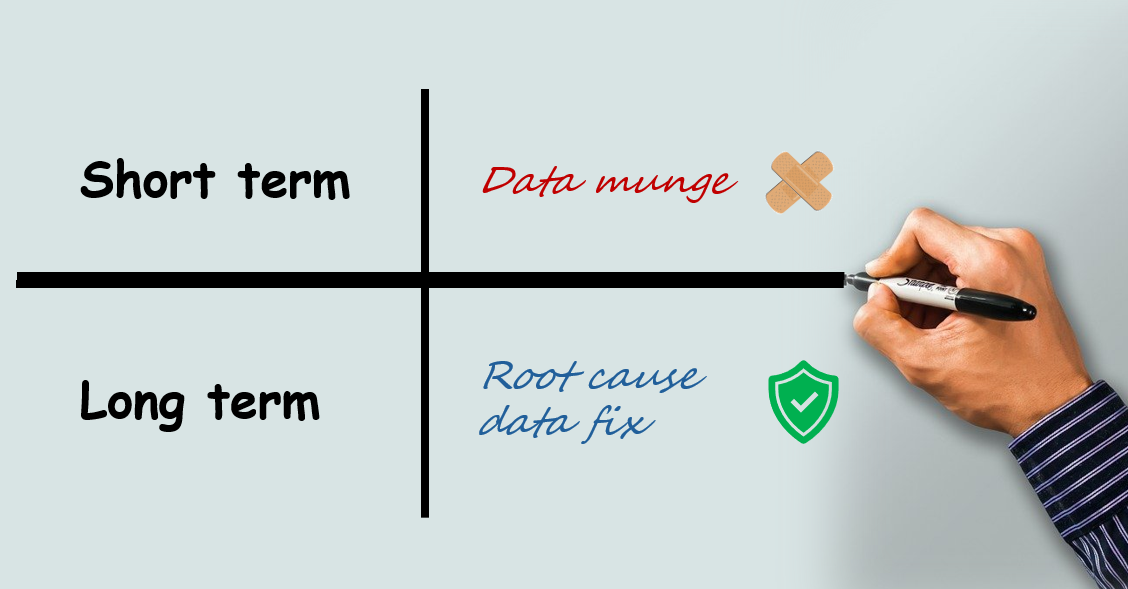
Data munging, also known as data wrangling, is the process of transforming and cleaning raw data into a more usable and structured format for analysis. This involves tasks such as removing inconsistencies, handling missing values, standardising formats, and correcting errors. The goal of data munging is to prepare data for more effective and accurate analysis. It is generally undertaken by the resources consuming the data at the time they seek to use it.

Root cause data fixing, on the other hand, focuses on identifying and resolving the underlying issues that cause data quality problems at their source. This approach aims to prevent the recurrence of data errors by addressing the root causes, whether they are due to flawed data entry processes, system bugs, or other sources of errors. It is generally executed as a business as usual (BAU) process.

Comparison: Data munging versus root cause data fixing
| Measure | Data munging | Root cause data fixing |
|---|---|---|
| Objective | Aims to clean and prepare data for immediate use in analysis or reporting. | Aims to identify and eliminate the sources of data quality issues to prevent future errors. |
| Scope | Typically, a reactive process applied to data sets as they are being prepared for analysis. | A proactive process that involves analysing and improving data collection, storage, and processing systems. |
| Timeframe | Often quicker, as it deals with immediate data cleaning needs. | Can be more time-consuming, as it requires a thorough investigation and changes to underlying processes or systems. |
| Effectiveness | Effective for short-term data cleaning but does not prevent future data quality issues. | More sustainable as it addresses and eliminates the causes of data quality problems. |
| Resources | May require less initial investment in terms of time and resources but can lead to ongoing maintenance costs, inefficiency and delays | Requires significant initial investment in analysis and system improvements but reduces long-term maintenance efforts. |
Which is better for data quality?
The choice between data munging and root cause data fixing depends on the context and goals of the organisation.
- Short-Term Needs: If the immediate priority is to prepare data quickly for analysis or reporting, data munging is a practical approach. It allows analysts to work with clean data without waiting for systemic fixes.
- Long-Term Data Quality: For sustained data quality improvements, root cause data fixing is superior. By addressing the underlying issues, organisations can ensure that data remains high quality over time, reducing the need for repeated cleaning efforts.
Integrated Approach
In practice, combining both approaches can be the most effective strategy for your organisation as follows:
- Immediate Data Cleaning: Use data munging to address urgent data quality issues and enable ongoing analysis and reporting.
- Root Cause Analysis: Concurrently, conduct root cause analysis to identify and fix the underlying problems causing data quality issues.
- Continuous Improvement: Implement a cycle of continuous monitoring and improvement to maintain high data quality standards.
By integrating data munging with root cause data fixing, organisations can achieve both short-term usability and long-term reliability of their data. However, ignore root cause fixing at your peril as failure to put in place a long term, sustainable business approach to data quality management will lead to inefficiency and failure to achieve business goals and successful outcomes for stakeholders.
Infoboss provide a data quality and compliance management platform to enable organisations to ensure their data is fit for purpose. It can be incorporated into your data pipelines to help embed a sustainable approach to root cause data fixing.