
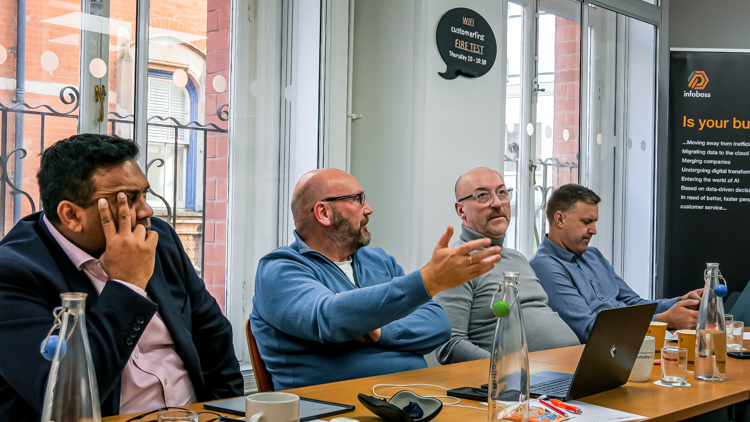
The recent infoboss unlocked event brought together leaders, partners, and sector specialists to explore how organisations are transforming their approach to data.
Across the sessions, speakers shared real world insights on governance, automation, regulation, agentic AI and the growing value of trusted information.
In Part 3. Robin Miller – Partner at 8 Governed Gates (8GG) – sets out the reality of data foundations. The message is unambiguous. When data foundations work, they are rarely noticed. They simply allow the business to move faster, with confidence.
Data foundations. Where business value really starts.
Every organisation wants more value from data.
Better decisions. Faster execution. Smarter use of automation and AI.
Yet most efforts begin in the wrong place. They start with platforms, tools, or analytics. Rarely do they start with the thing that actually creates value.
The business process.
Value does not sit in data. It sits in decisions.
Data on its own does nothing.
Value is created when data informs a decision, and that decision changes what a business process does next. Approve or reject. Dispatch or delay. Price up or down. Act now or wait.
When those decision points are clear, data has purpose. When they are not, data becomes activity without impact.
Strong data foundations begin by asking a simple question.
Which decisions matter most to how the business performs?
The hidden cost of weak foundations
Most organisations already sense where foundations are weak.
Decisions take longer than they should. Teams debate numbers instead of actions. Parallel spreadsheets appear because people want reassurance.
None of this feels dramatic.
It just feels like friction.
That friction is value leaking out of processes every day.
Why business process alignment changes everything
The most effective organisations anchor data to how work actually happens.
They start with end-to-end business processes.
They identify where judgement is applied.
They understand which data those decisions rely on.
Only then do they ask whether the data is good enough, well owned, and fit for use.
This shift changes the conversation.
Governance stops being abstract. It becomes practical.
Data quality stops being theoretical. It becomes contextual.
Investment decisions become clearer because they are tied to outcomes.
Ownership follows value
Where data supports real decisions, ownership becomes obvious.
Business leaders remain accountable for outcomes and value.
Named data owners take responsibility for whether data is suitable for use in those decisions.
Technology teams focus on enablement, not arbitration.
This clarity removes debate. It also removes delay.
Decisions move faster when everyone knows their role.
A quiet shift in how organisations operate
Data is no longer only used to explain what happened.
It increasingly drives what happens next.
Processes adapt in real time. Rules trigger actions. AI systems recommend or initiate decisions. In some cases, they act autonomously.
This does not reduce the need for foundations.
It increases it.
As automation grows, the distance between data and outcome disappears. Weak foundations show up quickly. Strong foundations create confidence and pace.
Progress beats programmes
World class organisations do not wait for perfection.
They focus on the data that underpins their most valuable processes. They stabilise it. They put simple ownership and controls in place. They learn as they go.
Within a short time, something shifts.
Conversations change from can we trust this? to what should we do next?
That is the moment value appears.
A different way to think about data foundations
Strong foundations are not about controlling everything.
They are about being clear on three things:
- Which business processes matter most
- Which decisions within those processes create value or risk
- Which data must be trusted for those decisions to work
Everything else becomes easier once that clarity exists.
The question worth asking
Imagine stepping into a key business process tomorrow and asking:
Which decisions here drive the most value, and how confident are we in the data behind them?
If the answer is immediate and shared, your foundations are already working.
If not, that is not a problem to fear.
It is an opportunity to focus.
Because the organisations that get this right do not just manage data better.
They run the business better.
Why this works
This approach works because it mirrors how organisations actually create value and manage risk.
- It starts with business processes, not data assets.
- It anchors data to real decisions, not abstract models.
- It makes ownership explicit without slowing delivery.
Most importantly, it respects the fact that not all data matters equally.
By focusing first on the decisions that drive value and exposure, effort is applied where it counts. Governance becomes proportionate. Control becomes visible. Progress becomes measurable.
This approach scales naturally.
It works just as well for manual decisions as it does for automation and AI. As processes evolve, the same logic applies. Clear purpose. Clear ownership. Clear boundaries.
It also creates evidence by design.
Decisions are not reconstructed after the fact. They are understood and recorded as they happen. This builds confidence internally and stands up to external scrutiny without changing how people work day to day.
Finally, it is practical.
It does not require perfection, large programmes, or years of investment before value appears. Organisations see benefits early because clarity reduces friction.
When data foundations work, they are rarely noticed.
They simply allow the business to move faster, with confidence.
And that is the point.